Nvidia CEO Jensen Huang Taps South Korea for Next-Gen AI Robotics, Driving 5G & Private Network Demand
📰Original Source: ETTelecomSource: In a June 5, 2026, report by ETTelecom, Nvidia CEO Jensen Huang identified South Korea’s robotics sector as the next major growth industry, leveraging the country’s semiconductor prowess and advanced manufacturing. During a high-profile visit, Huang highlighted strategic partnerships with major Korean…
Source: In a June 5, 2026, report by ETTelecom, Nvidia CEO Jensen Huang identified South Korea’s robotics sector as the next major growth industry, leveraging the country’s semiconductor prowess and advanced manufacturing. During a high-profile visit, Huang highlighted strategic partnerships with major Korean conglomerates, signaling a significant push into AI-driven automation that will have profound implications for telecom network infrastructure, particularly in 5G Advanced, edge computing, and private wireless networks.
The announcement underscores a critical telecom industry trend: the convergence of AI, robotics, and ultra-reliable, low-latency connectivity. For network operators, infrastructure providers, and investors, this move by the world’s leading AI compute platform signals a massive, near-term demand driver for high-performance, deterministic networks. South Korea, with its dense 5G coverage, fiber penetration, and government-backed digital initiatives, is positioned as a global testbed for the network requirements of next-generation industrial automation.
Technical Deep Dive: The AI-Robotics Stack and Its Network Dependencies
Nvidia’s vision for robotics extends beyond isolated machines to interconnected systems of intelligence. The technical architecture, built on platforms like Nvidia’s Isaac and Jetson, relies on a multi-layered compute model that imposes stringent demands on telecom networks.
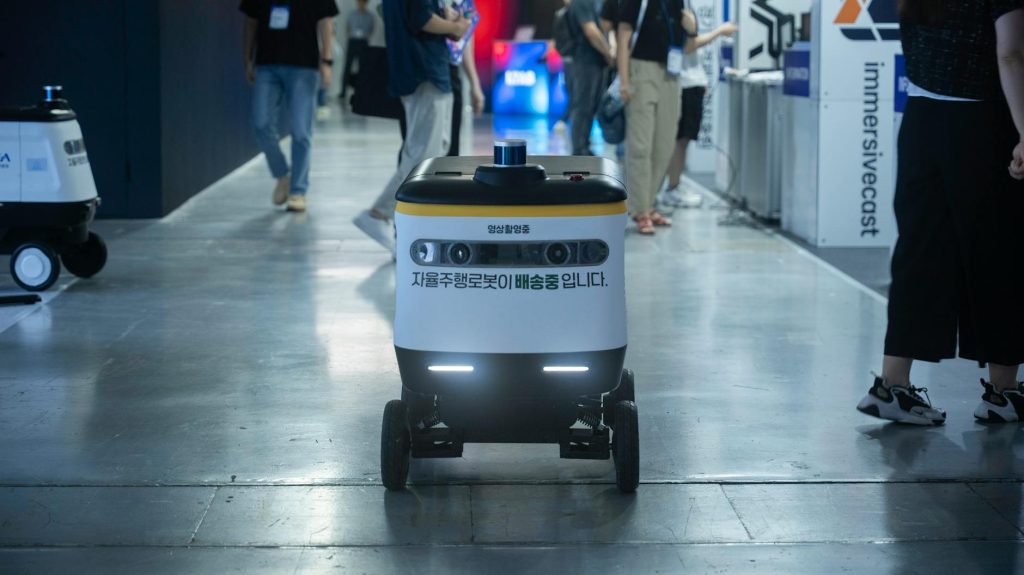
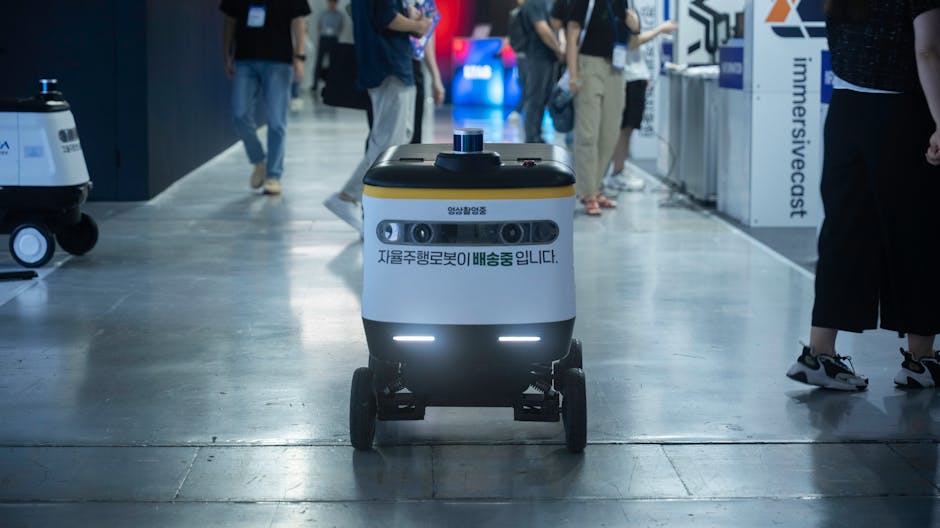
At the core is distributed AI inference and training. While onboard GPUs in robots handle real-time perception and immediate reactions (requiring sub-10ms latency), complex scene understanding, fleet learning, and digital twin simulations are offloaded to edge data centers or the cloud. This creates a continuous, high-bandwidth data exchange. A single AI-enabled robot in a smart factory can generate multiple 4K/8K video streams, LiDAR point clouds, and sensor telemetry, easily consuming 100+ Mbps of uplink capacity. Scaling this to hundreds of robots per facility necessitates fiber backhaul and high-capacity 5G or Wi-Fi 7 access networks.
The latency and reliability requirements are non-negotiable. For collaborative robots (cobots) working alongside humans or autonomous mobile robots (AMRs) navigating dynamic environments, network jitter and packet loss can cause catastrophic failures. This necessitates the use of 5G Ultra-Reliable Low-Latency Communication (URLLC) features, Time-Sensitive Networking (TSN) over Ethernet, and dedicated spectrum via private networks. South Korea’s operators—SK Telecom, KT, and LG Uplus—have been pioneers in 5G URLLC trials, making the market a natural partner for Nvidia’s ecosystem.
Finally, the management and orchestration layer requires robust, secure connectivity. Over-the-air (OTA) updates for robot software, centralized security patching, and real-time health monitoring of distributed fleets depend on always-on, secure links. This reinforces the need for telecom-grade service level agreements (SLAs), network slicing, and robust cybersecurity integration—core competencies of telecom operators moving into enterprise IoT and vertical solutions.
Industry Impact: New Revenue Streams for Operators and Infrastructure Players

The pivot towards AI robotics creates tangible opportunities across the telecom value chain, transforming network assets into critical enablers of industrial transformation.
For Mobile Network Operators (MNOs) in South Korea and similar advanced markets, the immediate play is in private 5G networks. Hyundai Robotics, Doosan Robotics, and Hanwha Systems—key partners cited by Huang—operate massive manufacturing complexes and logistics hubs. These are prime candidates for private 5G deployments, offering MNOs a lucrative alternative to stagnating consumer ARPU. Operators can provide not just connectivity but integrated solutions encompassing edge computing nodes (often powered by Nvidia GPUs), AI-as-a-Service platforms, and end-to-end security. The partnership between SK Telecom and Nvidia on AI data centers is a direct precursor to this model.
Network Infrastructure Vendors (Ericsson, Nokia, Samsung Networks) will see demand for hardware and software that supports precise timing, edge integration, and open APIs. The need for distributed radio units (RUs) and centralized units (CUs) that can interface with AI workloads at the edge will accelerate Open RAN and cloud-RAN architectures. Furthermore, the backhaul and fronthaul networks connecting these facilities will require significant fiber densification and upgrades to higher-speed wavelengths (e.g., from 10G to 100G/400G).
Tower companies and neutral hosts also stand to benefit. The deployment of small cells and dedicated on-premise radio infrastructure within industrial parks, ports, and warehouses will drive new site acquisitions and leasing agreements. The model shifts from broad macro coverage to targeted, high-value density deployments.
Critically, this trend validates the heavy investments in 5G-Advanced and 6G research. Concepts like integrated sensing and communication (ISAC), where the network itself can detect and map the environment for robots, move from academia to commercial roadmaps. South Korea’s strong R&D ecosystem, involving the Electronics and Telecommunications Research Institute (ETRI) and major universities, will likely see increased collaboration with Nvidia and telecom players on these next-generation standards.
Strategic Implications: South Korea as a Global Blueprint and Competitive Pressures

South Korea’s positioning in this shift is not accidental; it is the result of deliberate national strategy and existing infrastructure superiority. The country boasts over 90% 5G population coverage, near-ubiquitous fiber-to-the-home (FTTH), and a government committed to the “Digital New Deal” and smart factories. This makes it an ideal living lab. The lessons learned here—on network design, business models, and cross-industry collaboration—will be exported globally.
For other advanced telecom markets like Japan, Germany, and the United States, the Korean example sets a high bar. Industrial and manufacturing sectors in these regions will demand similar capabilities from their local operators, accelerating the rollout of 5G standalone (SA) cores and edge services. It creates a competitive imperative: operators that cannot deliver robust private network solutions for robotics and AI risk ceding the high-growth enterprise segment to hyperscalers (like AWS, Microsoft Azure) who are also aggressively partnering with Nvidia and moving into private wireless.
In emerging markets, including parts of Southeast Asia, the Middle East, and Africa, the implications are longer-term but significant. As automation becomes a key driver of economic competitiveness, nations investing in digital infrastructure today are laying the groundwork for future adoption. The demand for AI-ready data centers, high-capacity international cables, and robust national backbones will increase. For African and MENA telecom operators, the focus may initially be on providing the high-quality connectivity for logistics hubs, ports, and special economic zones where robotics first takes hold, often in partnership with global manufacturers.
The Nvidia-Korea alliance also highlights the growing geopolitical dimension of tech infrastructure. Control over the full stack—from semiconductors (Samsung, SK Hynix) to AI software (Nvidia) to networks (Korean telcos)—represents strategic autonomy. Other regions will seek to replicate this integrated capability, potentially driving protectionist policies or subsidies for local telecom and tech ecosystems.
Forward-Looking Analysis: The Telecom Network as the Robotic Nervous System

Jensen Huang’s endorsement of South Korea’s robotics future is a bellwether for the telecom industry. It confirms that the next wave of digital transformation—physical AI and embodied intelligence—will be fundamentally network-dependent. We are moving beyond connectivity for smartphones to connectivity as the central nervous system for autonomous systems.
In the near term (2026-2028), telecom operators must aggressively pursue partnerships with robotics OEMs, system integrators, and AI platform providers. The business model will evolve from selling SIM cards and bandwidth to offering guaranteed performance envelopes (latency, reliability, bandwidth) bundled with edge compute resources. Network slicing will become a commercial reality, driven by these industrial use cases.
Mid-to-long term, the data generated by billions of sensors and robots will become a strategic asset. Telecom operators, sitting at the data ingestion point, could develop new analytics and AI services, though they will face stiff competition from cloud giants. Furthermore, the extreme requirements of advanced robotics and spatial computing will be a primary driver for 6G research, focusing on sub-millisecond latency, AI-native air interfaces, and pervasive intelligence.
For infrastructure investors, the thesis is clear: assets that enable high-performance, low-latency, and secure connectivity for industrial AI—including fiber networks, edge data centers, and private spectrum—are positioned for sustained growth. The convergence heralded by Nvidia’s move in South Korea is not a niche trend; it is the beginning of a fundamental recalibration of telecom networks from consumer-centric to industry-and-machine-centric.